Explaining Advent to my disaffected teens
Help me Fleming, it’s rough out here

I try to maintain an open, discursive atmosphere with the young people in my orbit but the one topic that reliably kills our vibe is gun violence. We don’t talk about it often because we can’t; unlike other subjects of ethical contention, such as homie hopping, gossip, or environmental justice, gun violence seems so oppressively close, so overbearing in its promise of destruction, that bringing it up immediately forecloses the possibility of further discussion. There is nothing we can say because there is nothing we can do.
I get it; this isn’t totally true, and yes, I’ve signed petitions and donated money in hopes of stemming the epidemic of gun violence in America. I spent all of my twenties in youth work settings that advocated for both direct service and policy solutions, so I understand that theoretically, there is always something that can be done. Even so, standing in front of a room of adolescents who are smart enough to read the headlines and smart enough to know when I’m faking my responses is a harsh experience. There is no adequate theorizing in response to genuine distress. There is no ideological positioning, whether you want to argue the finer points of gun safety versus gun control, second amendment rights versus the promise of life and liberty, that will satisfy the real question at play. In the classroom, conversations about gun violence are conversations about how young people can metabolize the fact of evil in the world when so much in their environment is focused on denying its immediacy.
How does anyone do this well? I don’t know. I stumble whenever I am presented with the opportunity. I’m trying my best this year, having been given an opportunity to teach the literature of the New Testament, to speak as plainly as possible about the hunger and thirst for righteousness that Christ promises to reward, and to point to the obvious care that the God of the Scriptures shows to both the souls and the bodies of the people he created.
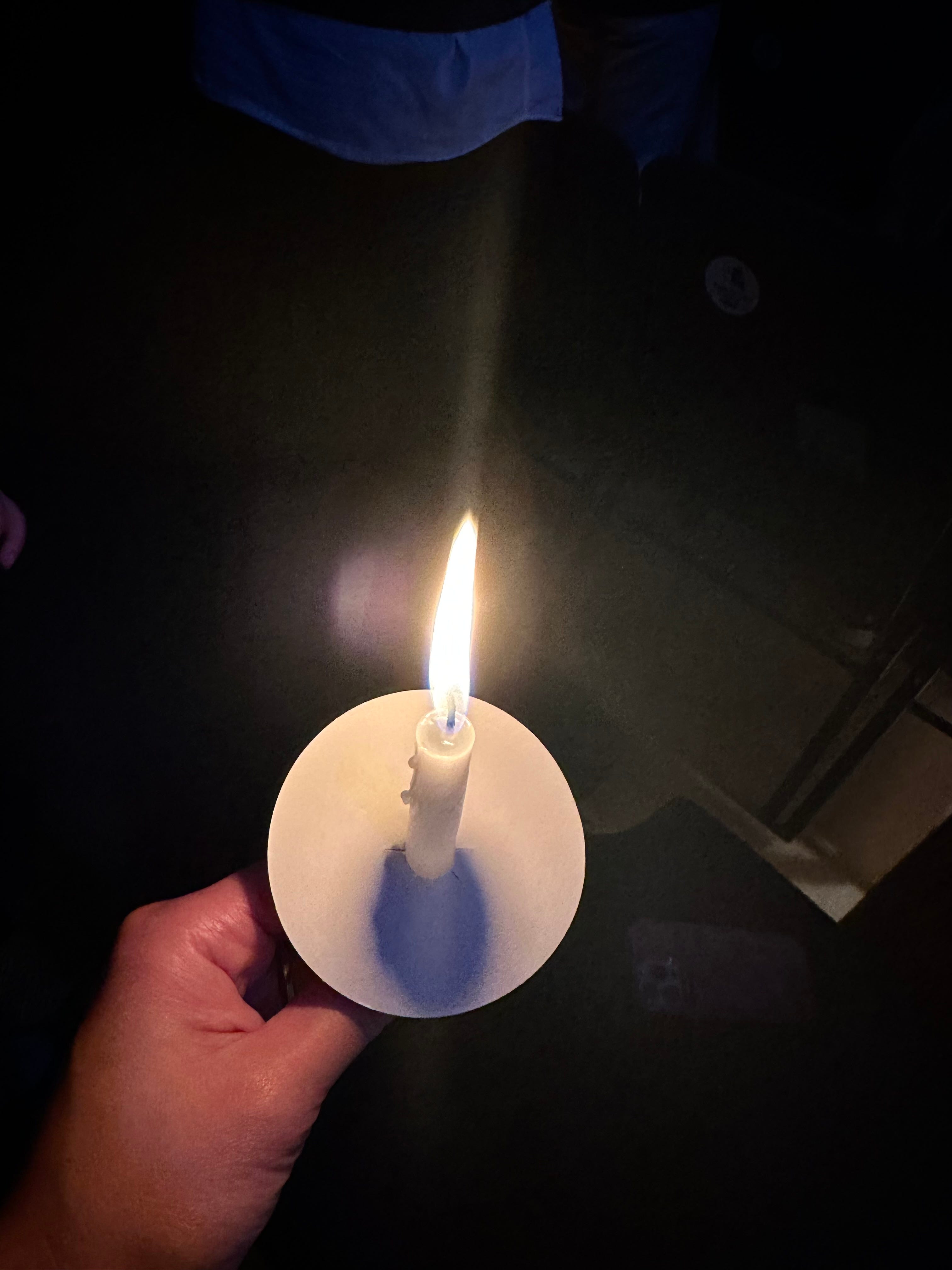
This brings us to Advent. Fleming Rutledge famously teaches that “Advent begins in the dark,” and the sense of darkness has been palpable all year. You do not need to believe the Scriptures to sense that something around you is wrong. The students are aware of this, and regardless of any divergence in our belief systems, this is a shared starting point. The emergence of Christ into the world is backlit by war and catastrophe and displacement; the story of his life does not theorize a response to human wickedness but allows the full scope of its depredations to be written onto his body. By the end of his life, Christ is visibly, permanently scarred by his years on earth.
I try, very awkwardly, to convey this to my students. They are not impressed by theory or punditry so I try to be as direct as possible. The fact of Christ’s arrival on earth, and the promise of his Kingdom, does not exempt his followers from suffering. And yes, he truly does ask his people to love their enemies, to pray for those who persecute them, to trust him to be their ultimate vindicator and judge. And no, this will not guarantee your safety in this life. But yes, I do believe him when he says that his Kingdom is not of this world, and it is at hand.
The day before we all left for winter break I read a short passage from Isaiah to my class:
“Every valley shall be lifted up, and every mountain and hill be made low; the uneven ground shall become level, and the rough places a plain. And the glory of the Lord shall be revealed, and all flesh shall see it together, for the mouth of the Lord has spoken.”
Isaiah 40:4-5
I had five minutes to explain these verses before we broke for Mariah Carey holiday karaoke. I gave my best effort—Advent and the arrival of Christ are not a denial of the world’s evil. They are the ultimate indictment of the wickedness you see and feel and cannot bear to acknowledge. There would not be any need for a Savior to arrive unless the world was enshrouded in darkness. There would be no need for his body to be pierced unless sin was a visceral experience, with a finality and torment that cannot be erased by theoretical arguments. And if the Advent season comes with an indictment, it also comes with a promise, which is that the glory of the Lord shall be revealed, and all flesh shall see it together. Then we had our party, and I don’t know if anything I said stuck.
There is a limit to what can be accomplished through theorizing, and this year has been an abrading experience for any of us who felt that we were capable of understanding and controlling our circumstances. Every ideology, every political argument sounds irritatingly glib when we are confronted with the fact of our helplessness. So, this is my prayer for my students, who are raucous and arrogant and young, and afraid to acknowledge what they are beginning to know about the world—and my prayer for the rest of us too, that we would understand the cosmic event of the Lord’s arrival as something that telescopes towards the granular pains and uncertainties of our lives, as a revelation of his glory that is also a validation of our need.